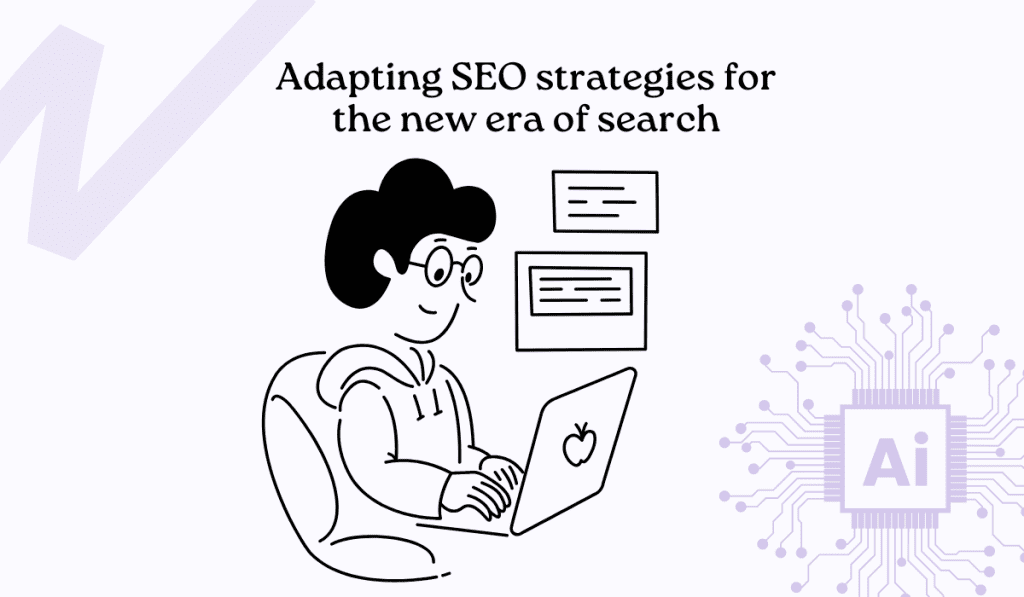
Last week, I watched a potential customer describe their exact needs to ChatGPT—budget, integrations, team size. The AI recommended three solutions. Ours wasn’t one of them. That’s when it hit me: I’d been optimizing for the wrong game entirely
The New Search Reality: Conversations, Not Queries
Here’s what’s actually happening in the wild. I tracked user behavior across three different companies last quarter, and the patterns were eye-opening.
Let’s take the B2B software space. We used to see prospects googling “CRM software,” bouncing through review sites, maybe downloading a comparison guide. Standard stuff. Now? They’re having full conversations with AI: “We’re a 50-person insurance agency currently using mainly Microsoft Excel sheets and Outlook for most of our work. Half of my team is over 50 and hates learning new software. What CRM won’t cause a revolt?”
The AI tools don’t just come out with options. It explains why Lavanya, an accountant working at XYZ company will struggle with Salesforce but might actually like HubSpot’s interface. Your meticulously crafted “Best CRM for Insurance” page? Never even enters the conversation.
I saw this interesting pattern everywhere. An e-commerce client noticed something weird—people weren’t searching for “Nike Air Max” anymore. They were asking AI things like: “My flat feet are killing me, but I love how Air Max looks. What else has that chunky aesthetic but won’t destroy my arches? Need them by Friday for a wedding.”
The local service industry got hit differently. Plumbers used to fight for “plumber near me” rankings. Now customers ask: “My 1960s house has some weird pipe situation under the kitchen sink. Which Seattle plumber actually knows old houses and can come today?” AI systems can pull from review sites, licensing directories, and real-time integrations (if connected), giving users the impression of personalized vetting.
The Dual-Track Strategy: Playing Both Games
I’ll be blunt—anyone telling you to abandon SEO completely is selling something. Google still processes billions of searches daily. But pretending nothing’s changed is equally delusional.
Track 1: The SEO Evolution
Traditional search isn’t dying, but it’s morphing into something more transactional. People google when they know exactly what they want. They chat with AI when they’re figuring it out.
A financial services client learned this the hard way. Their “What is a 401k?” article tanked—down 70% in six months. But here’s the kicker: searches for “rollover 401k to Fidelity IRA forms” shot up 40%. People weren’t asking Google to educate them anymore. They wanted Google to take them directly to the action.
So we pivoted. Killed the fluffy educational content. Built calculators, embedded forms, created step-by-step transaction guides. Basically, we assumed every visitor already knew what they wanted and just needed to do it.
Track 2: The GEO Game
Generative Engine Optimization sounds fancy, but it’s actually straightforward once you understand how these systems work.
But here’s where it gets interesting. A travel client of mine built what we called “AI Context Pages”—constantly updated feeds of real pricing and availability. When someone asks ChatGPT about beach vacations in March, newer AI search tools can tap into our real-time data instead of serving up prices from 2023. Fast forward six months—their AI-referred bookings were up 200%.
The Technical Reality Check
Let me save you some expensive mistakes. Current AI models don’t crawl your site like Googlebot do. Base AI models are trained on snapshots of the internet up to a specific cutoff date. But newer AI search tools now layer in retrieval to pull fresh data when available.
That means you need both historical authority and real-time freshness.
The New Optimization Framework
Forget everything you learned about keyword density. I mean it. The game has completely changed.
Semantic Richness Beats Repetition
Stop counting keywords. Start building topic webs. When you write about project management, don’t repeat the phrase fifteen times. Instead, explain resource allocation, discuss timeline dependencies, dive into stakeholder communication. AI understands relationships between concepts better than most SEO tools.
Why Structure Is Everything
Schema markup used to be nice-to-have for rich snippets. Now it’s survival. But I’m not talking about basic Article or Product schema. It’s getting granular. Mark up your FAQs, your how-tos, your comparisons. Use JSON-LD to explicitly state relationships between concepts.
A recipe site client went deep on this. They didn’t just mark up ingredients—they created substitution matrices, scaling calculations, altitude adjustments. Now when someone asks AI about adapting high-altitude recipes for sea level, guess who gets cited?
The Authority Paradox
Backlinks still matter, but not in the old PageRank sense we focused on a few years ago. AI leans more on citation authority and original data sources, so it’s less about sheer link volume and more about being the primary source other sites reference.
Real Implementation: The 90-Day Roadmap
Week 1-4: Stop the bleeding. Check if AI can even access your site. Fix your robots.txt. Add comprehensive FAQs that sound like actual human questions, not keyword soup. You can experiment with llms.txt—a proposed standard (still early-stage) to help AI systems interpret your site’s structured data.
I worked with a SaaS company that discovered AI was completely misrepresenting their product pricing. They added a section called “Common Questions from Users” and created a structured pricing endpoint specifically for AI crawlers. It fixed the problem almost instantly. Bonus – Their web page got listed under the ‘People also ask’ section of Google SERP.
Week 5-8: Restructure your content. Transform feature pages into comprehensive guides. An education platform client changed their “Python Course” page from a sales pitch to an actual resource—prerequisites, realistic time investment, honest competitor comparisons/reviews, and real student feedback. AI tools started recommending them for “career switchers with Excel experience wanting to learn Python.”
Week 9-12: Measure what matters. Forget rank tracking—you can’t check your position in ChatGPT. Tracking AI mentions is still manual and experimental. You can monitor citations in tools like Perplexity or watch referral data for AI-driven traffic patterns, but there’s no standardized measurement yet. Compare conversion rates between traditional and AI-referred visitors to see if the quality difference holds true.
An e-commerce client discovered something fascinating: The AI-referred visitors had triple the average order value but half the return rate. The AI was much better at matching the right products to needs than their own search function.
The Competitive Edge: Beyond Traditional SEO
- Original Data Wins – Everyone’s regurgitating the same content. Be the source instead. A startup HR software company within a limited budget couldn’t compete on competitive keywords like “employee engagement”. So they published a quarterly “Remote Work Burnout Index” using anonymized user data. Now they’re the authoritative source AI cites for remote work trends. More qualified leads than years of traditional SEO ever delivered.
- Radical Transparency Builds Trust – This goes against every marketing instinct, but it works. A fitness app started publishing “Why users leave us for competitors” reports. They analyzed their own churn data publicly. Crazy? When users ask AI about the app’s downsides, the AI cites the company’s own honest assessment. This approach builds trust instead of suspicion.
- Dual Optimization – Your content needs to work for humans and machines simultaneously. NOT either/or. Both. Think of it like responsive design, but for intelligence types. Make it scannable for humans, parseable for machines, valuable for both.
The Skills Question
Do I need to learn coding and prompt engineering? Here’s my take: You don’t need to become a developer, but you’d better understand how these systems think.
Learn basic prompt engineering—not to game the system, but to understand how users actually query AI. Understand APIs because integration opportunities are everywhere. Get comfortable with structured data formats. Think in terms of version control for content.
But don’t panic. The fundamentals haven’t changed. We’re still solving user problems. We’re still building trust. We’re still creating value. The distribution channel is evolving, not the core mission.
Quick Takeaways
- Don’t abandon SEO → focus on transactional intent.
- Experiment with GEO → structured data + authority content matter more than ever.
- Publish original datasets → become the source AI trusts and cites.
Looking Forward
The winners won’t be those who choose between SEO and GEO. They’ll be those who recognize these as complementary channels. Your website or SEO isn’t dying—it’s evolving from a destination to a node in an intelligent network.
Build for authority. Optimize for understanding. Create genuine value. The algorithms—Google’s or OpenAI’s—will figure out the rest. The search box isn’t disappearing—it just learned how to think. Maybe it’s time we did too.